
La Montagne
31 August 2023
A united effort to restore the church
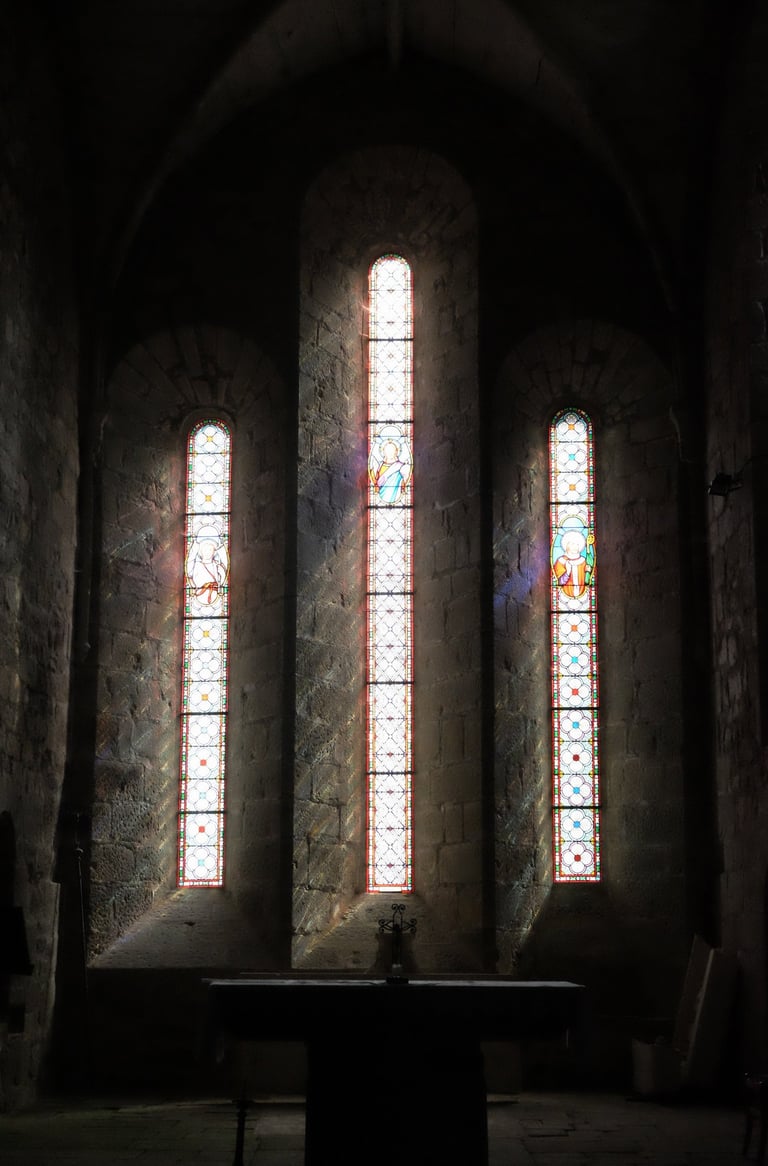
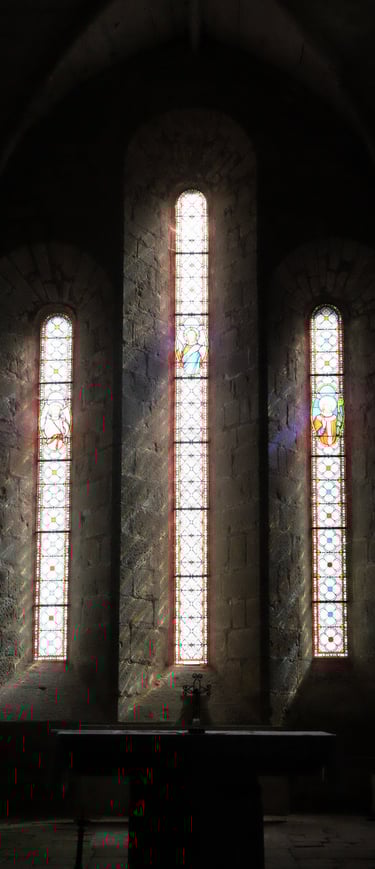
In Chamberaud, all that remains today of the former 13th-century commandery is the chapel and the square tower, which has been converted into a bell tower. It is still an imposing structure, but one in need of major restoration work. A project that a local residents’ association is determined to see through to completion.
It cannot be said that Chamberaud church is blessed by the heavens. “It’s been struck by lightning twice…,” recalls Michel Giron, smiling. “That’s bad luck, isn’t it, especially when it’s a storm in February?!” Fortunately, the listed building can count on the unwavering support of the commune’s habitants.
Starting with Michel Giron – who was mayor until 2020 and is now president of l’Association de la valorisation du patrimoine historique de Chamberaud (the Association for the Promotion of Chamberaud’s Historical Heritage) – and Philippe Buisson, a descendant of masons from the Creuse region who hailed from the commune, from whom he inherited both a house and a love of stone. Both are among the twenty or so residents of the commune (which has a population of one hundred) who work within this association, founded in the 1990s.
The cost of the work? Ten times the commune’s budget
For whilst the restoration of this former commandery has been a priority for successive local councils, the project is far too costly for the council’s finances: “The work is estimated at €600,000, which is ten times Chamberaud’s budget,” explains Michel Giron. “Even if we received the maximum amount of grants, the council would still have to cover 20% of the costs.” Work has already been carried out in the past – the most recent involved the sacristy – but it’s a never-ending cycle. Above all, there is the issue of safety. The former mayor was very concerned about the condition of the interior flooring: he would have liked to have the paving replaced, as it was quite dangerous for the elderly, and also to have the entrance to the cellar secured, but this didn’t happen because the heritage architect wanted the interior paving to remain as it was: lifting every single paving stone to replace them one by one – can you imagine how much that would cost?? It’s a listed historic monument, and ultimately there are more drawbacks than benefits.”
A first meeting announced for the annual European Heritage Days
Safety measures, roofing, paving…: the works are indeed substantial and essential today, if only to open the church more often, in complete safety.
Postponed time and again due to their cost, will the association be able to see them through ?? The will is there, in any case.
“The current mayor is aware of the work that needs doing, but it’s a very big project,” says Philippe Buisson. “He asked the association if we could take it on. So we’ve had a quote drawn up and we’d very much like to receive support from the Heritage Foundation. And even from the Heritage Lottery Fund. But the building needs to be of particular interest. We’re counting on the fact that it’s a Templar site…”
The association therefore plans to launch a fundraising campaign and has already announced its first event, to coincide with Heritage Days (*): a talk on the history of the building by Jean-Marie Allard, author of a study on the Hospitallers and Templars in the Creuse. It will take place in the church itself. A sign of things to come ??
Séverine Perrier
(*) Saturday 16 September at 2.45 pm
La Montagne
29 november 1995
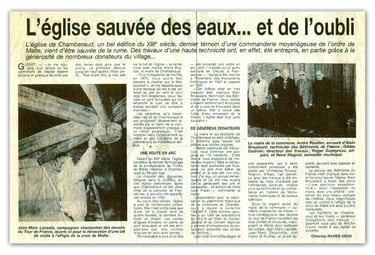
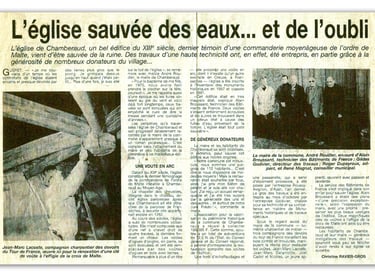
The church saved from rain water damage…and from oblivion
The church at Chamberaud, a fine 13th-century building and the last remaining vestige of a medieval commandery of the Order of Malta, has just been saved from falling into ruins. Highly technical restoration work has, in fact, been undertaken, partly thanks to the generosity of numerous donors from the commune…
GUERET. – “I remember a time when the church’s buttresses were overrun and almost devoured by ivy thicker than a fist. I used to climb right to the top of them when I was a boy… More than once, I went up onto the church roof,” recalls André Roudier, the mayor of Chamberaud, with a mischievous smile.
“For my daughter’s christening in 1970, we nearly had the bell tower fall on our heads,” he continues. “I also remember a time when the tiles were flying about in the wind, and quite a long time ago now, two bays collapsed, which prevented the priest from saying Mass for about fifteen years.”
The trials and tribulations endured by Chamberaud church and its gradual decline, as recounted by the mayor of the village, read almost like a picaresque novel… But that is to overlook the deep attachment of the mayor and the village’s residents to this majestic building.
An arched vault
Dating from the 13th century, the church is the last remaining trace of the Commandery of the Order of Malta established in Chamberaud during the Middle Ages.
The Knights’ Chapel, incorporated into the keep, became a parish church after Chamberaud was separated from the parish of Fransèches, to which it still belonged in 1282.
Over the centuries, the church has undergone many changes. It consists solely of a single nave with a straight chevet, comprising four bays, the last of which forms the chancel. The original stone ribbed vaults collapsed and were replaced by wooden ribbed vaults with liernes.
Remarkable in more ways than one – it features an arched vault, of which there is only one other example in the Creuse, at Fransèches – the church was included in the Inventory of Historic Monuments in 1957 and listed in 1991.
“This building was in a very poor state,” explains Alain Broussard, a technician with Bâtiments de France. “Two vaults had completely collapsed and the others were in a pitiful state due to water leaks from the roof. The church was barely salvageable.”
Generous donors
The mayor and the residents of Chamberaud rallied together at the eleventh hour to save this building with its noble origins.
“Our commune is tiny; we’re just a handful of 112 residents... That gives you an idea of how limited our resources are! But everyone wanted the restoration to go ahead, so I took up my pilgrim’s staff and went to see each and every one of them. I received a wonderful welcome and was very surprised by everyone’s generosity… and especially that of our parish priest, Frédo!”, comments the mayor.
The association for the promotion of the historical heritage of the commune of Chamberaud managed to raise 190,000 francs. This sum, combined with a total of 72.5% in grants from the State, the General Council and the Regional Council, enabled the complete restoration of the building’s vaults to be undertaken.
A forest of scaffolding and a walkway, which served as temporary shoring, was erected last year by the firm Roussy-Avignon, based in Ajain. The bulk of the work was undertaken in October by the firm Godivier, chosen for its technical expertise and competence in the field of historic monuments and specialist works.
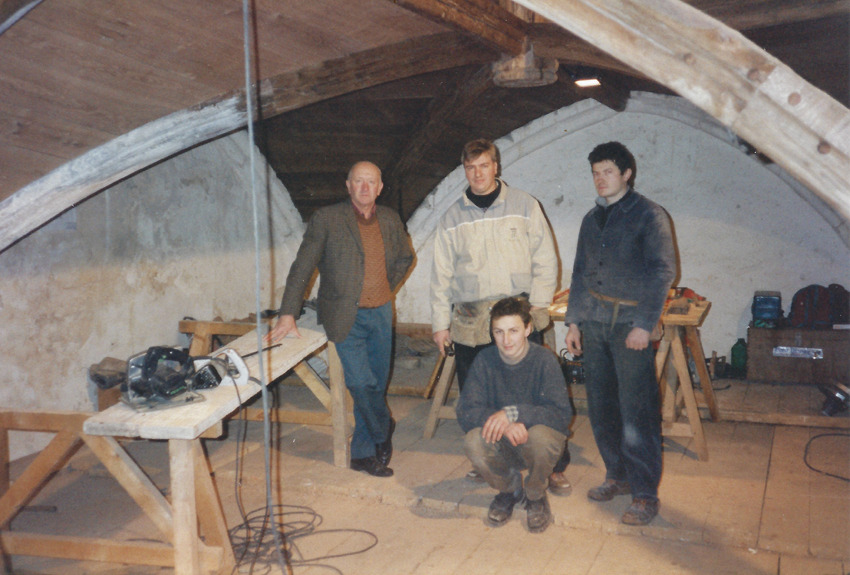
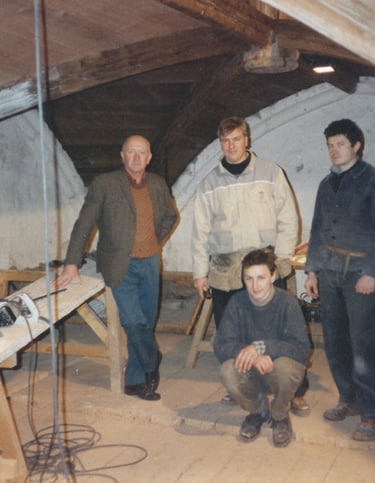
Under the watchful eye of the mayor of the commune – himself a carpenter by trade – three journeymen from the Tour de France guild work on the curved and moulded timber, handling the resin to restore the vaults. Jean-Marc Lacoste, Jean-Marc Delamotte, Joël Caillet and Nicolas, a young apprentice, work with passion and dexterity.
The Bâtiments de France department threw its full weight behind the effort to save the church. Alain Broussard drew up plans of “exceptional precision”, in the mayor’s words, with one priority: to preserve the building’s finest surviving features. Two magnificent keystones bearing the Maltese cross were thus restored.
The residents of Chamberaud and their mayor – the generous driving force behind the work – will soon be able to congratulate themselves on having restored their church to its former splendour.
Christine Ravier-Gros
The work in 1998 – on the left, André Roudier
February 1977
Histoire d’un coup de foudre en l’église de Chamberaud
The history of the church
In his speech, the mayor gave a long, detailed account of the history of this church, which ranks among the most beautiful in the area.
Citing specific details, he focused on the state of the building, its misfortunes, and the subsequent works to be carried out, which have required a great deal of effort.
Whilst the first phase of works (the roof), carried out by the firm Roussy, was funded by a government grant and an exceptional allocation from the Ministry of the Interior, the second phase (the vaults), which cost 567,183 francs, was funded by grants: 50% from the Ministry of Cultural Affairs; 10% from the Region; and 17.5% from the General Council. Miscellaneous donations amounted to 176,700 francs.
The mayor therefore provided a great deal of information about this renovation, which has been very well received by the local community. Deeply moved by the collective generosity that saved the church, he expressed his sincere thanks to all the donors, as well as to the local authorities, the tradespeople, and, of course, all those whose goodwill contributed in various ways to the church reopening its doors.
Finally, the audience was invited to a reception in the village hall.
Perched on one of the highest points of the village, the church is a large, solid building of considerable value.
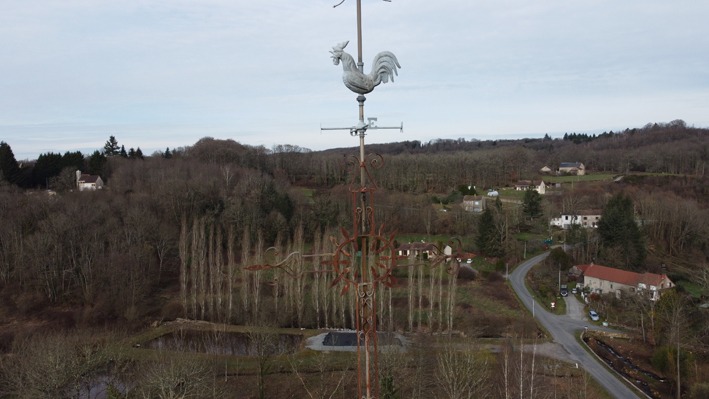
Firmly anchored on its eastern side by buttresses of heavy cut stone masonry, which seem to shield it from any harm, it has stood the test of time for several centuries. Dating from the 13th century, it has endured the ravages of time, compounded by a lightning strike on 10 February 1977 which seriously damaged it: as a result, it had to be closed to the public and the services celebrated by Father Fredo were consequently suspended…
Aware of this situation, the local council and residents did not sit idly by; ideas were put forward, donations collected and funding secured.
The firm Roussy then undertook the restoration of the roof.
Listed in the supplementary inventory of historic monuments in 1957, the interior still needed to be refurbished, particularly the vaults, which were in a precarious state. This difficult, specialised operation was successfully carried out by the firm Blanchon.
It was certainly a lengthy process, but after numerous difficulties, delays and administrative procedures, it has come to a successful conclusion, so that the church has once again opened its doors to the faithful.
Moreover, the mayor, André Roudier, expressed his satisfaction at having brought this project to a successful conclusion.
The official opening of this restoration project—and more specifically of the vaults, which attracted much attention and favourable reviews—took place last Saturday, 3 August, at 3 pm, in the presence of a very large crowd, including, in addition to the local council, the following: Mr Jean Auclair, Member of Parliament; Claudine Lucantis, Regional Councillor; and Thierry Chandernagor, General Councillor.
The mayors of Fransèches, Sous-Parsat, Saint-Sulpice and Ahun; Mr Albert Lacolley, former Prefect of Creuse; Mr Houlette from the Ahun Tourist Office; Mrs Jacqueline Larpin, tax collector for Saint-Sulpice; Mr Branssind from the departmental architecture office; Mr Jean-Louis Peyne, former local schoolteacher; Father Fredo, the gendarmerie.
Further articles will be posted online shortly.