Project to develop the site of Moulin du Puy
April 2000
University diploma " Management and Development of Rural Space and Heritage"
University of Limoges & Ahun Agricultural 6th Form (15- to 18-year-olds)
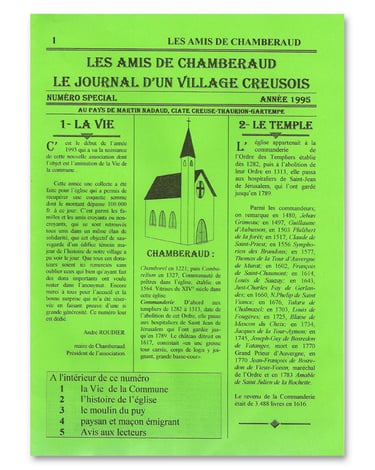
Newspaper
Les Amis de Chamberaud
(The association Friends of Chamberaud)
February 1995 (journal no° 1)
Below, part of the content has been reproduced.
Page 2 (article 3) :
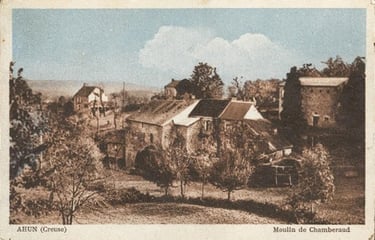
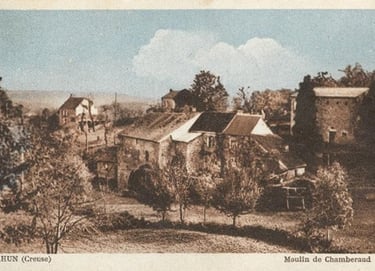
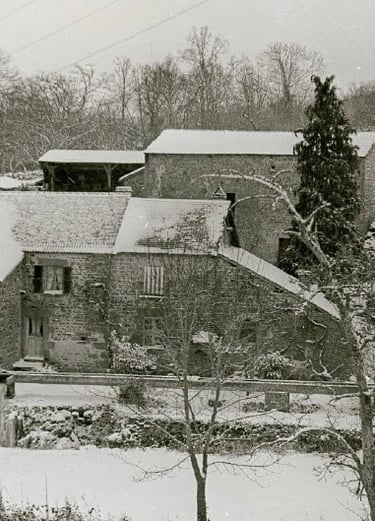
The Puy Mill
by René Magnat
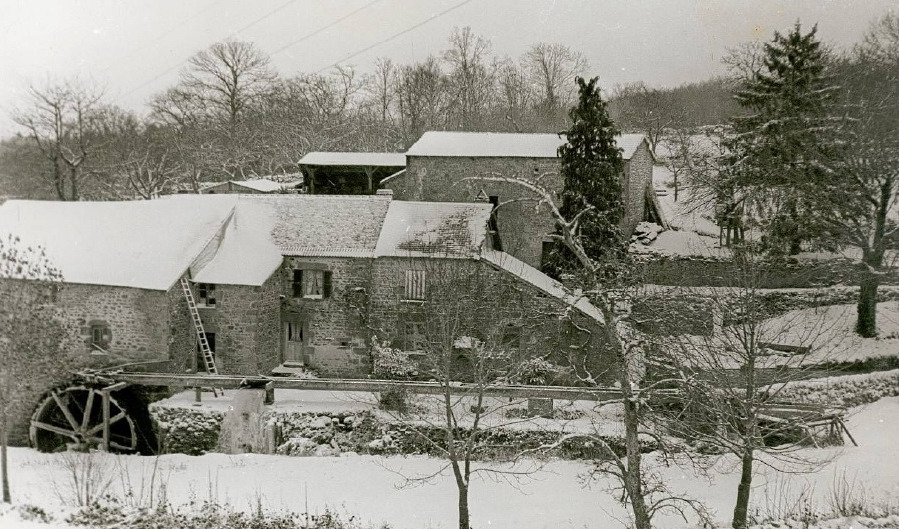
Once upon a time, there were three small mills nestled together in a small valley at the foot of a pond... The first, closest to the stream, was an oil mill. The oldest residents still remembered, until recently, "Father Saja" with his long white beard and his smock, stiffened by many oil harvests. The recipient of the oil from this oil press, made out of stone, still remains from this mill, where mainly walnuts were processed. The second was a fulling mill. The water conduit that provided the power to drive the hammers that calendered the hemp cloth is still visible today. Finally, the third was a flour mill. These three mills formed the present-day site of the Puy mill at Chamberaud...
The mill was purchased around 1860 by a man named Clédière. At that time, it consisted of only one pair of millstones with the sifting machine located beneath them. Clédière had three children: two sons, Sylvain and Jean, and a daughter. Sylvain Clédière became the owner in 1877 and undertook significant renovations..
A bill of specifications dated June 23, 1878, written on stamped paper [paper stamped with a seal subject to payment] between Sylvain Clédière, owner of the Puy mill, and the LHOUMMEAU mechanical works, located on the Paris-Limoges road, describes a two-ring waterwheel, which "will have the diameter that the fall allows," and a pair of millstones, the runner stone made of La Ferté stone and the fixed stone [bedstone] made of Domme stone. These millstones will be 1.55 meters in diameter and spoked, "they will produce good merchandise, both in terms of whiteness and quality. »
To compensate for the lack of water in 1881 to due to the summer period, Sylvain Clédière added a 6 HP Gérard system steam-powered portable engine to his mill: Here is the mill equipped with a second motive force which will allow it to produce without interruption.
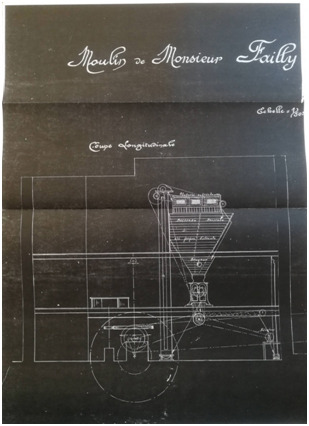
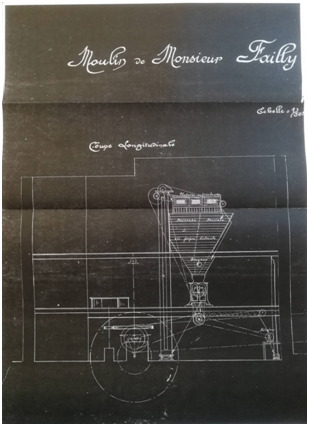
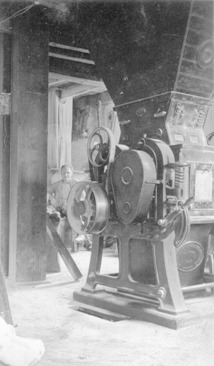
Around 1898, Joseph Failly, Sylvain Clédière's son-in-law, took over the mill. He, in turn, made significant modifications. It is likely he who transformed the mill into its current form. Around 1907, he replaced a pair of millstones with a grinder and a converter, and enlarged the buildings so that the sifting process took place above, rather than below, the grinding level.
The mill will therefore consist, as it does today, of a ground floor, a first floor, plus the attic where the sifting machine is located. Modernized, it is likely during this period that the mill will experience its most prosperous era, no longer content with grinding local wheat, but bringing in grain from the cereal plains, and even from abroad.
Joseph Failly will buy back the oil mill and demolish it, which will allow him to build the current road serving the mill.
It's worth noting that the mill was the first building in Chamberaud to be lit by electricity. Indeed, by possessing the "water rights," the miller was authorized by the then-powerful EDF (French Electricity Board) to produce electricity for his own use. It should be remembered that the commune of Chamberaud only knew the arrival of electricity [la fée électricité, the electricity fairy] in 1934/1935. It was 10 years later that the steam engine was replaced by an electric motor.
In 1940, two years before Joseph Failly's death, one of his sons, René Failly, ran the mill while awaiting the return of his two brothers, prisoners of war in Germany. Upon their release in 1945, André and Lucien took over the management. Lucien later died from an illness contracted in the German camps. André then ran the mill alone until his retirement in 1973.
Since that time, the mill, which for decades had been the lifeblood of the village through both prosperous and dark times, has fallen silent forever. The village elders remember when farmers delivered their grain to the mill, and the miller supplied the baker directly with the flour, which provided bread for the farming families. And this often happened without any money changing hands. Each party received their payment through the delivery of goods.
During the Second World War, after the defeat of 1940 and the subsequent German occupation, the mill played a vital role in supplying flour to the rural population. At night, with sacks of wheat slung over their shoulders, farmers would carry their grain to the mill along the narrow paths of the Creuse department, returning with the same flour, essential for baking delicious loaves of brown bread in their family ovens. This supplemented the meagre rations provided by the official food rations. All of this required great care and trust, as the risks involved were considerable.
Photos from: Le Moulin Du Puy - Site Enhancement Project (2000)
Professional project, University Diploma in ‘Management and Enhancement of Rural Areas and Heritage’, University of Limoges & Lycée agricole d’Ahun (Ahun Agricultural College)
Wilfried Leymarie, Thierry Pillot, Marjolaine Pimont, Valérie Ruch, Frédéric Schaeffer
Here, then, is a summary—perhaps with a few omissions, for which we hope you will excuse the author—of the history of the Puy mill, recently and wisely acquired by our town. Indeed, it was by a unanimous vote that the town council, following the mayor's lead, decided that the mill would become municipal property. We extend our gratitude to all those for whom the word "heritage" is not an empty word. No doubt there will now be no shortage of goodwill to gradually bring this relic of the past back to life. YES, one day we will see the wheel of OUR MILL turning.
Page 3 à 8 (article 4) :
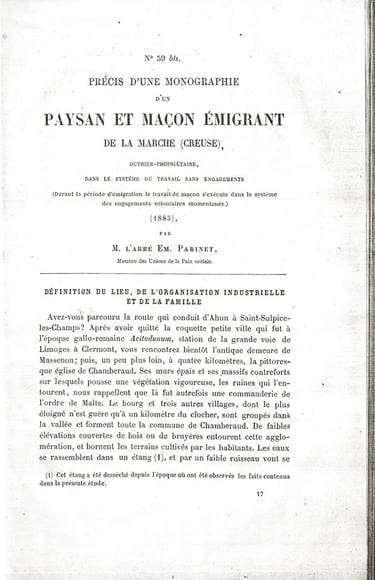
Peasant and mason emigrating
from La Marche
By Abbot E.M. Parinet, Member of the Unions for Social Peace. 1885
According to "A summary of a monograph of a peasant and mason emigrating from La Marche - (La Creuse), a worker-owner, in the system of work without commitments (During the period of emigration, the work of a mason is carried out in the system of temporary voluntary commitments.)
DEFINITION OF PLACE, INDUSTRIAL
AND FAMILY ORGANISATION
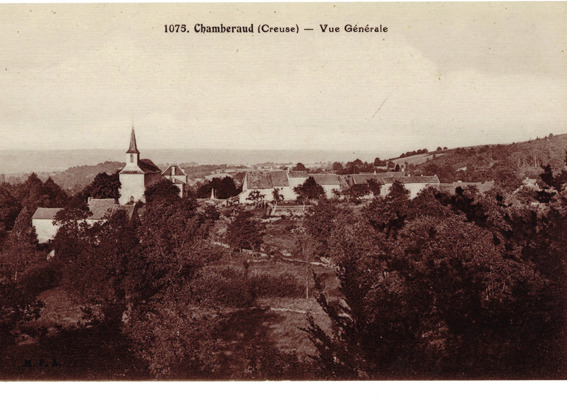
Have you travelled the road from Ahun to Saint-Sulpice-les-Champs? After leaving the charming little town that was, in Gallo-Roman times, Acitodunum, a stop on the main road from Limoges to Clermont, you soon come across the ancient villa of Massenon; then, a little further on, four kilometres away, the picturesque church of Chamberaud. Its thick walls and massive buttresses, on which vigorous vegetation grows, and the ruins that surround it, remind us that this was once a commandery of the Order of Malta. The centre and three other villages, the furthest of which is barely a kilometre from the church steeple, are clustered in the valley and form the entire commune of Chamberaud. Low hills covered with woods or heathland surround this settlement and mark the boundaries of the land cultivated by the inhabitants. The waters gather in a small lake (1), and via a small stream flow into the Creuse river, a little downstream from Lavaveix-les-Mines. It is where we have chosen, as the subject of our study, a family of emigrants. Located roughly in the centre of the department, with average altitude and fertility, it represents well the type of social and economic situation of a large number of our fellow citizens.
The farmers of La Creuse divide their department into two parts in a very precise manner: they call the districts of Guéret and Boussac the "plain." There, the soil is less poor, agriculture more flourishing, and consequently, emigration less frequent. Conversely, they call the district of Bourganeuf and most of the district of Aubusson the " mountain": here the altitude is higher, the soil drier; there are larger uncultivated areas; agriculture is less profitable, and the lack of railways has thus far kept the region away from agricultural progress, in particular the use of lime and chemical fertilizers. Chamberaud, which is part of the district of Aubusson and, by its proximity to Ahun, borders the district of Guéret, lies midway between these two regions. Its small lake, which can be taken as the average elevation point, is 508 meters above sea level. The commune's territory covers 738 hectares; arable land accounts for 388 hectares; meadows for 140; and woods for 60. The remainder comprises uncultivated land: heaths, streams, paths, etc. The soil consists of a thin layer of topsoil resting on a yellowish tufa used as mortar for construction, on peat in the vicinity of the lake, or most often directly on granite. This granite, the base of the ground, is arranged in irregular masses that are often exposed; its grain is very fine and it provides fine building stone. Thanks to the ease of finding such excellent materials, the houses are generally well-built. Of the 113 houses in the commune: 16 have two stories, 84 have one story, and only 12 have only a ground floor. All are built of rubble stone with corners that are more or less well cut .
The population is 431 inhabitants, of whom 204 are male and 227 female. The population change over the past ten years is as follows: marriages, 21; births, 55; deaths, 60. There are no large landowners in the commune: it is divided into small properties, generally barely sufficient to provide sustenance for their owners. These properties are subdivided into a large number of small plots, intertwined with one another. The rural area we are studying, in this respect, falls squarely into the category that F. Le Play calls villages with fragmented and peripheral inhabited places. A number of plots are enclosed by hedges or walls, and are no larger than 30, 20, or even 15 ares. This excessive fragmentation is far from conducive to agricultural progress. Transporting crops and fertilizers and repairing fences represents a needless expenditure of energy and time for the farmers. Consequently, the state of agriculture in Chamberaud is the same as it was thirty years ago; the land continues to be prepared in the same way with similar tools, and the same seeds of rye, buckwheat, oats, etc., are sown. Wheat is harvested only in small quantities and on rare occasions. Moreover, the soil is poor and infertile. Faced with these conditions, the able-bodied part of the population has long wondered whether they should remain attached to this unyielding land. Undoubtedly, improving the land would increase yields; but where could they obtain the necessary funds? Undoubtedly, too, by redoubling their efforts, they could live on their few hectares of land; but when the time comes to pay for siblings, to marry off their daughters, where would they find the necessary resources? And the stingier the land proves to be, the more the peasant seems to become attached to it; he cannot bear the thought of selling the estate where his ancestors worked .
It was under these circumstances that our man decided to leave his home, his elderly parents, his wife, and his children, to seek in richer lands the resources he could not find at home. This is why, for a long time, the inhabitants of Chamberaud have become masons and gone to work in our eastern provinces or in Paris. They leave every year during the month of March, spend the summer working, and return to their families in December. As soon as the children reach fifteen or sixteen, they accompany their fathers and learn their trade. The younger children, the women, and the elderly must, during this time, take care of the farm work, which obviously suffers from this lack of able-bodied labourers. Currently, out of approximately 140 workers, the commune has 60 emigrants, masons or stonecutters; only 44 devote themselves exclusively to farm work, and most of them are elderly. Six go daily to work in the Lavaveix mines, which are 6 kilometres away; 26 are employed as artisans in various trades—blacksmiths, clog makers, weavers, etc.; and finally, 4 are innkeepers. A number of these emigrants, heads of households, are thrifty and bring back the fruits of their labour at the end of the year, which vary from 400 to 800 francs. Others, especially among the younger ones, spend more, return with little, and end up squandering the fruits of their labour during the winter.
This tradition of emigration is passed down from father to son in Chamberaud; for a long time, most of the inhabitants have been engaged in the masonry trade, already well-established in this commune. In a land register, drawn up at the request of the Commander of the Knights of Malta (2) residing in Chamberaud, in December 1682, we find all the inhabitants of the parish who appeared before the notary, listed as farmers and masons. We were able to examine another register from October 1723: the same qualifications are found there, and moreover, as the workers had not yet returned home, a number of them are represented by their wives and noted as being outside the province.
In the current state of our legislation, and in such an infertile region, it seems difficult to establish primogeniture. However, it is every peasant's dream to leave one of his children full ownership of his property. Here are the methods used to achieve this. The disposable portion is almost always given by marriage contract to the eldest son; an advance on inheritance, the cost of which is borne either by the savings of the father and the favoured son, or by the dowry of the daughter-in-law, or by borrowing, is granted to each of the other children who leave the family at the time of marriage. During the father's lifetime and his joint work with the eldest son, property purchases and investments of savings are made in the latter's name. Upon his father's death, he thus finds himself in a position to pay his brothers the inheritance rights they may have over the deceased's estate, which, moreover, is most often valued below its actual worth in family arrangements. Furthermore, the number of children tends to decrease more and more: parents limit this number to two or three, sometimes one, and many frankly admit that it is the heirs they fear. With all these precautions, a great many succeed in their aim; but they obviously cannot achieve that powerful organisation of the domestic household, that vitality, that strength of the primogeniture described by F. Le Pay. (3).
The family described herein consists of six people : Jacques Z***, the grandfather, 75 years old; - Léonard, his son, a family father, 48 years old; - Maria, his wife, 43 years old; - Eugène, the eldest of their children, 22 years old; - Mathilde, their daughter, 20 years old; - Octave, their second son, 10 years old.
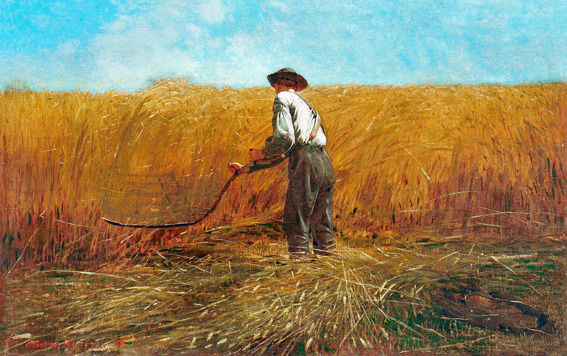
Jacques was a stonemason who emigrated; for the past twelve years he has remained in the region and farmed the land. He is still vigorous and devotes himself, perhaps with less strength but with as much enthusiasm as the younger men, to the various farm tasks; like them, he scythes, threshes in the barn, etc. Léonard is also a stonemason; he spends nine months in Paris and only the three winter months in Chamberaud. Eugène accompanied his father during the last three growing seasons; This year he is doing his military service. Mathilde married last year to a young man who had not yet completed his conscription; she returned to spend the year her husband remained in the regiment with her family. In the parish of Chamberaud there is a great deal of indifference toward everything related to religion; in some individuals, this indifference turns into hostility. Church services are poorly attended; especially men rarely come to church, even on feast days. The majority of families still observe Sunday as a day of rest, but more out of habit than religious conviction, and as soon as a task seems even slightly urgent, very few hesitate to undertake it, even if it means harness their beasts of burden. At haymaking and harvest time, almost everyone works on Sundays. Absorbed by material concerns, greedy for gain, selfish, deliberately dismissing thoughts of death and the afterlife, and exposed to hearing a host of objections to religion from a few fanatics or reading them in certain newspapers, most of the inhabitants of Chamberaud live in practical materialism. On certain days, however, the idea of a God and a Providence impose themselves upon them, and the blessings of the Church are still sought at birth, marriage, and death. There has been only one civil funeral so far; it was that of a young man who had taken part in the insurrection of 1871 in the name of the Paris Commune, and who boasted of having been one of the murderers of the hostages: he added this detail (I quote his words): “One of them, a priest, asked us to aim for his heart; But I shot him in the mouth to make him suffer more; and he began to jump around like a rabid dog.” Every time he told this story, he ended it with a burst of laughter.
MEANS OF LIVING FOR THE FAMILY :
The buildings owned by the family (22,670 francs) came from the parents' inheritance, augmented by savings or the daughter-in-law's dowry. First, a house, 2,000 francs. Then a barn, with a threshing floor in the middle; a cowshed with a hayloft above; a sheepfold, with a storeroom for sheaves above; together, 1,500 francs. Bakery, pigsty, and henhouse, 600 francs. Finally, a property comprising: a vegetable garden and hemp field (15 ares), 800 francs; an orchard (40 ares), 1,200 francs; arable land (4 hectares), 4,800 francs; meadows divided into three parts (2 hectares 85 ares), 9,250 francs; pastures (1 hect.), 1,500 fr.; coppice woods (60 ares), 720 fr.; chestnut grove (30 ares), 300 fr. [1 hectare = 100 ares]
At his daughter's wedding, the father incurred a debt of 2,000 francs; 500 francs were spent on the wedding and 1,500 francs were given as an advance on the inheritance. The family retains approximately 100 francs as working capital.
Domestic animals consist of: 4 cows, 800 francs.; 1 heifer of 18 months, 150 fr.; 18 sheep, 180 fr.; 1 donkey, 90 fr.; 1. dog 6 fr.; 1 fattening pig, 50 fr.; 6 chickens 8 fr.
The special farming equipment is valued as a whole at 586.50 francs; namely: 1 long, two-wheeled transport cart, called a galière, 120 francs; 1 dump cart, 110 francs; 1 donkey cart with harnesses, 150 francs; 1 plow, 30 francs; 2 ard plows, 14 francs; 1 wooden harrow with iron teeth, 34 francs ; 2 yokes with fittings, 20 francs; 2 sieves, 4 francs; 1 winnowing fan, 24 francs; 1 double-décalitre [a French grain measuring bucket], 3 francs; 4 flails, 4 francs; 1 wheelbarrow, 5 francs; 2 ladders, 20 francs; 2 pitchforks and 2 hoes, 6 francs; 2 wooden buckets, 4 francs; 1 other in tinplate, 2.50 francs; 10 earthenware milk pots, 1 large earthenware bowl for churning butter, 11 francs; 2 scythes, 5 sickles, 4 rakes and 6 wooden forks, 25 francs. Gardening tools, 12 francs; mason's tools, 30 francs; weapons and hunting equipment: 2 rifles, 150 francs; 1 haversack, 10 francs; 1 cartridge pouch, 5 francs.
Only a few years ago, the village inhabited by the family possessed a fairly large expanse of communal fields, which served as pasture for the cows and especially the sheep belonging to all the landowners. These lands were divided among the inhabitants into very small plots (some are only 20 ares), each wanting a piece of the most fertile sections; this extreme fragmentation prevented the division from producing the expected benefits. This was the family's only source of income; unless one applies that term to the free education received by the youngest child, even though it is a common right and paid for by taxes.
The grandfather and daughter-in-law take care of the various tasks required on the property. They get up around three or four o'clock in the summer, and around seven in the winter. The wife first milks the cows, then prepares the first meal; while she attends to household chores, her father-in-law tends the cattle or takes them to the fields. Immediately after supper, they get to work on the different tasks required for running the farm, which vary with the seasons. In winter, there's threshing, repairing implements and fences. Then come the spring ploughing and sowing, the major work of harvesting hay and wheat, and finally, preparing the land and sowing in the fall. Jacques Z*** and his daughter-in-law, helped by the emigrants during their stay in the country, manage these various tasks: this year they only paid one woman for seven days at 1 franc each for haymaking, and another for six days at 3 francs each for help with the harvest. The practice of mowing wheat is becoming more widespread, but the family has not yet adopted it. The rye harvest was threshed for the first time with a small machine powered by a horse, which was rented for 15 francs a day; but they also had to feed the landowner and five neighbours who came to help. The family did not find much profit in doing it this way: the straw was much more broken than it would have been with flails and is no longer suitable for repairing the barn roof. Since the neighbours’ day was unpaid, the custom of preparing two large meals had to be followed, which increased the expense. The thresher machine processed 400 sheaves, yielding 82 double-décalitres of grain. The remaining 200 sheaves were threshed during the winter, producing 41 double-décalitres.
During their stay in Chamberaud, the two emigrants helped with the winter work, and the mother then focused solely on household chores. In Paris they worked almost constantly; the father, in particular, never took holidays or Sundays off, only resting on payday and the days following. The son worked more frequently, and while the father's average workday was 250 hours per year, the son's average was barely 220. They were both paid by the hour, at the usual rate of 75 centimes; but the length of their workdays varied with the seasons, being shorter at the beginning and end of the harvest than in the middle. The average workday was slightly less than 10 hours.
We are not talking about the work of the daughter Mathilde, who only lives in the house temporarily, and who, moreover, is mostly occupied with the care required by her young child. Before her marriage, she shared her mother's chores.
FAMILY WAY OF LIFE:
The peasant of the Creuse region is generally very frugal at home. The family we are studying, in particular, subsists almost exclusively on the produce of their own farm. Grains, vegetables, fruit, eggs, dairy products, and pork form the basis of their diet. Rye provides a substantial, wholesome, and pleasant-tasting brown bread; the housewife kneads it herself every fifteen or twenty days and bakes it in the family oven. She only buys white bread on holidays; the small quantity of wheat harvested on the farm is used to occasionally prepare some simple pastries. Buckwheat is eaten in the form of pancakes cooked over a fire, which are called crêpes or tourteaux in the region. Every year, around Christmas, when the farm workers return home, they slaughter the "petit salé," that is, a pig, whose gross weight usually exceeds 100 kilograms. Its meat is a favourite dish on winter Sundays: a piece is boiled to season the morning cabbage soup, which is then served and eaten at lunchtime. The family drinks cider, milk, or water; wine is only consumed during major work periods and at gatherings at the inn on holidays or market days. It is also the usual drink of emigrants in Paris.
The timing and number of meals vary with the seasons. During hay making and harvest time, that is, from June 20th until the first days of August, there is a first meal around 6:00 a.m.; it consists of eggs seasoned in various ways, cream, cheese, or candied fruit. At 11:00 a.m., the workers eat soup, a dish of butcher's meat very often prepared with peas, cheese, etc. Around 4:00 p.m., they are served milk into which they crumble brown bread; then salad, potatoes fried in butter, fat, or walnut oil. Finally, around 8:00 or 9:00 p.m., there is a last meal consisting of soup and the leftovers from the previous meals. The two main meals are usually eaten in the fields where the work is being done. During the rest of the year, the family eats only three times a day: soup around 9:00 a.m.; Various kinds of vegetables or dairy products are eaten around 2 o'clock, and soup again around 7 o'clock. However, the evening soup is often replaced by boiled potatoes eaten with milk, or by chestnuts.
Here, in contrast to this very frugal diet, is the diet of the two emigrants in Paris: in the morning, before going to work, they take a small glass of brandy; at 10 o'clock, their first meal, consisting of bread, wine, a soup with beef and vegetables, and another vegetable dish or dessert. At 2 o'clock, they have a "breakfast," as they say, meaning they eat a piece of bread and cheese and drink a small glass of wine. In the evening, their last meal, similar to the one at 10 o'clock, sometimes a little more substantial.
The house is built of rubble masonry plastered with lime; the corners, openings, and entablature are made of dressed stone; the roof is covered with local flat tiles. The dwelling consists of a cellar, a ground floor, an upper floor, and an attic. The cellar is used for storing cider, fruit, and potatoes. The ground floor includes a kitchen, built of dressed stone, where the family eats and usually gathers; a small room where the grandfather sleeps; and the dairy. Above, the layout is similar: a bedroom for the father and mother; and rooms for the children. The barn and stables, thatched, are attached to the house and located in the same courtyard.
The furnishings are neither luxurious nor refined; they are even rather uncomfortable and barely adequate. First, there are four oak beds: two modern, the other two old, crudely made, and almost entirely enclosed like large closets. Each bed has a straw mattress, a goose-feather duvet, a bolster, two wool blankets, and curtains. The value of the four beds, including bedding, is 800 francs. The other furniture consists of: two cherrywood wardrobes, 240 francs; two bedside tables, 20 francs; a bread bin, 20 francs; a clock with a long, painted case made of fir, 35 francs; a chest of drawers with a shelf above, 30 francs; a table in the kitchen with a bench on either side, 30 francs; two other tables in the bedrooms, 20 francs; and a dozen chairs in the various rooms, 36 francs. - A few books, and some coloured and framed engravings, 2 mirrors, together, 40 francs.
Household utensils are reduced to the bare essentials: cast iron or earthenware pots, wrought iron or pewter spoons, bowls, earthenware dishes, plates, glasses, earthenware cider ewers, bottles, coffee pots, casks, grill, frying pan, coffee cups, 47 francs. - iron fire dogs with ash guard, shovel and tongs, bellows, old-fashioned lamps, known as chalet lamps, small kerosene lamp, lantern, 19.25 francs. - Hammer, pliers, files, a few carpenter's tools, etc., 20 francs; 10 bread baskets, 10 francs; 1 hook for weighing, 2.50 francs; needles, thread, and accessories for women's work, 5 francs.
The household linen is coarse but sturdy; it is made of hemp cloth, harvested and spun at home, then woven in the surrounding area: 15 pairs of sheets, 200 francs; towels and dishcloths, 25 francs; 10 sacks for flour or grain, 10 francs.
Work clothes are made with local wool; holiday and special occasion clothes are bought. Young men, and especially young women, seek out the fashions of neighbouring towns, their parents hardly giving it a second thought. The women's hairstyle is typical of the region: a headdress of embroidered white tulle or muslin, quite elegant in shape, and costing up to 20 or 25 francs. - Grandfather's clothing: 1 suit (jacket, waistcoat, and trousers) in blue coarse cloth, 1 thick black merino wool tie, 4 pairs of blue wool stockings, 1 pair of shoes, 6 handkerchiefs, 12 shirts, 1 hat, 103 francs; for work: half-worn holiday clothes, 2 pairs of clogs, 1 wool waistcoat, 47.50 francs. - Father's clothing: he buys ready-made clothes in Paris; For the holidays: 1 overcoat, 1 waistcoat and 1 pair of trousers in grey cloth, 2 silk caps, 64 francs; for work: a brown velvet suit, 2 or 3 smocks in poor condition, 1 wool waistcoat and 1 pair of canvas trousers, 12 shirts, 1 silk scarf, 1 pair of ankle boots, 2 pairs of clogs, 12 handkerchiefs, 4 pairs of wool stockings, 121.50 francs; 1 watch, 40 francs. - The eldest son's clothes are worth 207 francs; those of the second son, 78 francs. - The mother's clothes: 2 black merino dresses, 2 drugget dresses, 9 head dresses, 3 pairs of clogs, 3 merino camisoles, 18 shirts, 158 francs; for workdays, she wears worn clothes, 80 francs. - 1 gold watch, 1 pair of earrings, 2 rings, etc., 200 fr.
A characteristic fact is that the family rarely enjoys leisure time together; except for an annual gathering on the patron saint's day, to which a few relatives are invited, each member seeks their own pleasures separately. The grandfather rarely goes out; in the summer, however, he is the one who goes to the fairs to buy and sell. He never returns without having gone into an inn with some friend and had a pint of wine. The pints follow one another in sufficient quantity that our man, now in a good mood, almost always returns home singing. The mother goes to the market in Ahun every week to sell dairy products, eggs, or fruit; she doesn't eat there and returns around two or three o'clock. She enjoys this trip because it takes her away from the monotonous daily routine and because, as she says, it allows her to see people. The leisure activities of the two emigrants in Paris are varied. First, there's the cabaret, which they frequent quite often, even on workdays, especially in the evenings. Small theatres, café-concerts, and circuses also tempt them sometimes. Finally, they participate in the political meetings of the workers of the Creuse region. During the winter, they also frequent cabarets on fair and market days. Both use tobacco extensively. In addition to the father's pastimes, he reads a local newspaper. They never go for walks together; in winter, the wife sometimes dines in town with her husband; but it's not uncommon to see her leave in the morning before him and return the same way. This way of behaving recalls the humorous remark by Abbé Roux in his Pensées: "The peasant offers his arm to his wife on their wedding day, for the first and last time."
FAMILY HISTORY :
Jacques Z*** was born in Chamberaud, where his ancestors had long been established. At the age of fifteen, he set off on foot, as an apprentice, for Franche-Comté, where he went every year to work as a mason until he was sixty. He had three children: a son and two daughters. With the help of his son, he was able to pay his daughters a dowry of 1,500 francs, and in recent years, wanting to dissuade them from claiming any part of his future estate, he gave each of them another 1,500 francs. A pension of 240 francs was stipulated in his favour in the settlement, but he has not claimed it. At various times, properties were purchased; all the deeds were executed in the name of his son, Léonard. Léonard accompanied his father from the age of fifteen to twenty-five. At that time, he believed that Paris would offer him more advantageous work, and he left for the capital. It was toward the end of the Empire; wages were indeed high, but expenses were also greater, and, in the end, he recognized that his earnings were roughly the same. However, he did not change his place of emigration. Until his arrival in Paris, he had maintained a respect for religion and remained indifferent to political matters. From that time on, he frequented meetings where the most extreme ideas were presented and read the most progressive newspapers. Since 1870, he has shown himself hostile to everything related to religion and a very ardent republican; during his time at home, he actively promoted his opinions every winter. Today, perhaps calmed by age, perhaps disappointed in the hopes that the new regime had raised in him, he is rapidly returning to his former indifference.
Leonard Z*** does not belong to any mutual aid society. Having achieved a certain level of comfort, he makes a small profit each year which, in a short period of time, will extinguish his debts, which are, moreover, quite small. He also hopes that his son will marry soon and that his daughter-in-law's dowry will provide him with a comfortable living. In case of unemployment or illness, he would have the option of retiring to his property, the income from which would be sufficient to support him.
ANNUAL HOUSEHOLD BUDGET :
FAMILY RECEIPTS: 3.194 fr.
Property income.......................... 428 fr.
Subsidy proceeds........................ --
Salaries....................................... 2.187 fr.
Profits of industries..................... 579 fr.
DÉPENSES DE LA FAMILLE: 2.617 fr.
Food............................................ 1.719 fr
Housing....................................... 221 fr.
Clothing....................................... 262 fr.
Moral needs, recreation and health services ..... 285 fr.
Debts, taxes and insurance…….... 130 fr.
EMIGRANT'S BUDGET (during the nine months of absence):
Revenue: Wages from 250 average days of 10 hours at 7.50fr., 1,875fr.
Expenses: Food, 270 days at 3.50fr., 945 fr.; lodging, 54 fr.; clothing, 102 fr.; travel, recreation, etc., 200 fr. Total, 1,301.
Profit: 574 fr. (included in the annual budget above).
Savings of approximately 577 francs are allocated annually to paying off the family's debts.
(1) This pond has been dried up since the time when the facts contained in the present study were observed.
(2) This commandery held extensive rights over all the surrounding villages; it collected tithes from five parishes, but it retained its character as Hospitalier. The commander owed a pound and a half of bread to each person in the parish of Chamberaud, and the distribution took place every Sunday after Mass. The inhabitants relinquished this payment when he relinquished his right to the communal oven. He also paid alms of 104 sétiers of wheat-rye, Ahun measure, or approximately 125 hectolitres, to all those coming and going from the said parish. This right was regularly collected by the inhabitants from 1623 to 1741, as evidenced by various records drawn up before a notary in the commandery's granaries. Following transactions around 1750, this alms was abolished and the knights' rights diminished. In 1781, those concerned again demanded it in court; the reduction of duties had primarily benefited the rich, while alms had primarily benefited the poor. (The sétier of Ahun was equivalent to 6 double decaliters; it sold for 6 livres in an average year towards the end of the last century. The average value of a pair of oxen was 300 livres.)
(3) Social Reform in France, Book III, Chapter XXX.
This decline in religious spirit appears to have several causes, some general, others purely local. It is quite certain that since 1870 faith has diminished and religious practices have declined in our countryside: the poorly educated population has been unable to resist the constant attacks directed against the dogmas and morality of the Catholic Church. The hostile press has had a particularly disastrous effect on people's souls, especially in the parish of Chamberaud. As for the workers who migrate to Paris, they find themselves in the most unfavourable circumstances from our perspective; not having Sundays or holidays off, except perhaps payday, they do not participate in any religious services. I know workers who have been going to the capital for twenty years and who have never set foot in one of its churches. No religious instruction reaches them, and they are thus perfectly prepared to receive and accept the revolutionary or immoral doctrines that they hear being promoted or see being put into practice. Furthermore, no priest resides in the parish; it is the priest from a neighbouring parish who comes every Sunday to celebrate Holy Mass in the church, which is closed all week; he is the one who visits the sick and fulfils the various functions of the sacred ministry. Whatever his zeal may be, this distance is necessarily an obstacle to good. Finally, it must be added that the last memories left by the Knights of Malta, memories that the older generation passes on to the younger, do not leave a favourable impression of this institution, and by extension, of all religious institutions. The commanders, at least in the years preceding the Revolution, often abandoned their residences, leaving it to procurators or farmers to collect the dues owed to them. These farmers, who were profiting handsomely, sometimes resorted to exactions, or at least somewhat harsh methods, which outraged the cultivators. To make matters worse, the order's properties, sold as national assets, were bought by a sworn priest who married and became the progenitor of a family that remained at home until recent years. These are the reasons that seem to partly explain the indifference and hostility mentioned above.
Paternal authority is scarcely more respected. As soon as young men begin to emigrate, they inevitably escape their father's influence, and during their short annual stays in their homeland, they think much more about pleasures and recreation than about family chores. Festivals, weddings, fairs, and markets are all occasions for them to gather, where morality and sobriety suffer greatly. These habits generally last until marriage. Young women also easily free themselves from maternal authority. During the winter especially, they frequent neighbourhood dances, often staying until two or three in the morning, and return home alone or in the company of the young men with whom they spent the night. Many parents lament this state of affairs; but very few dare to try to remedy it, and when they speak of it, they can only say sadly : "Youth must have its fling; one mustn't stand out, one must do as everyone else does."
There are hardly any close relationships between neighbours; everyone keeps strictly to themselves. As inheritances are intertwined, frequent disputes arise between owners regarding boundary demarcation and land use; but these quarrels rarely go beyond the justice of the peace.
The family we are describing is indeed in the situation indicated above, from a moral and religious point of view. The mother, daughter, and youngest child attend church for major holidays; the other family members do not participate in any Catholic worship. Leonard and his eldest son brought back from their stay in Paris what one might call very progressive ideas. The son was fined two years ago by the court in Aubusson for causing a disturbance in the church on a wedding day. Relations within the family are cold, without the arguments and tensions that are so visible elsewhere. The grandfather has given his property to his children; his authority in the family is non-existent, and he inspires little sympathy except for the services he provides through his work. The death of the grandmother, which occurred a year ago, did not bring great sorrow to the household. The priest, alerted by strangers, offered her the last rites and performed the Christian burial rites. A very small number of people attended the religious services held in her honour.
All members of the family attended school and can read and write. For over thirty years, the small commune of Chamberaud has had a boys' school and a girls' school. Compulsory education has not changed school attendance; the children attend fairly regularly, except during periods of high workload.
The village is in good health. The food is wholesome. Thus, apart from illnesses brought back from emigration centres, chest infections, and colds that can result from fieldwork and a lack of precautions, diseases are quite rare. The Z*** family enjoys good health. Discomfort is infrequent, even among the grandfather, despite his seventy-five years. The doctor is only called in serious cases. This is, moreover, the custom of most peasants in the region; they consult a doctor too late and often when the illness is so advanced that his medical knowledge is useless.
Long established in the village, the family has only enjoyed a certain level of comfort in recent years. Their selfish and somewhat quarrelsome nature, along with the behaviour of its members, do not earn them much respect in the community. The father has, however, been a town councillor since 1875; but he owes this position far more to his progressive ideas than to the esteem his fellow citizens hold for him. Moreover, among these people, wealth, honesty, and a dignified life inspire as much envy as respect. In marriages, parents primarily seek wealth for their children, and when a young woman of marriageable age is mentioned, it is not uncommon to hear the expression: "She's a 10,000-franc girl." As for virtue, moral worth, and honour, these are secondary matters.